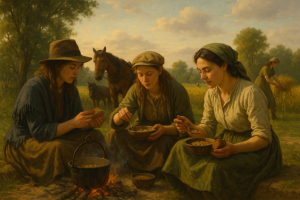
Introduction — When the Kitchen Met the Garden
In the Victorian age, the line between garden and kitchen was not a boundary but a bridge.
Behind almost every country house — and many modest homes — lay a patch of earth that fed the family table through every season.
The garden was an extension of the kitchen, the pantry before the pantry, the quiet engine that sustained life.
Here, self-sufficiency was a rhythm, not a slogan.
The cook and gardener worked in partnership, guided by the calendar and by habit.
Fuel, flame, soil, and salt replaced modern convenience; everything was made from scratch, by hand, and with care.
This week-long journey imagines a Victorian kitchen-garden household as it lived — not the polished world of period dramas, but the daily rhythm of soil and flame, labour and reward.
Monday — Dawn across the Beds
The week begins with the sound of hinges creaking on the glass frames. Mist rises from the vegetable beds.
The gardener checks the forcing pits for heat; the kitchen-maid gathers herbs and early greens, her apron damp with dew.
As James Shirley Hibberd wrote in The Amateur’s Kitchen Garden (1877),
“The kitchen garden should so be managed that one crop ends as another begins — the store of the house never wanting.”
Each plant had purpose. Brassicas in the bed, peas and beans in succession, early cucumbers under frame.
The mistress of the house checks her account-book, as Mrs Beeton’s Book of Household Management instructs —
“A housekeeping account-book should invariably be kept, and kept punctually and precisely.”
From the first light, the house moves as one organism: soil outside, scullery within.
Fuel is fetched, fires kindled, kettles filled. The air smells of damp earth and coal smoke — a fusion of world and hearth.
Tuesday — Harvest and the Scullery’s Steam
The second day brings abundance.
Turnips, onions, herbs, perhaps early strawberries from the glasshouse — all carried in wicker baskets to the kitchen door.
Inside, the cook begins the triage:
- What will be eaten today.
- What must be preserved.
- What needs blanching, pickling, or salting.
Without refrigeration, everything must move quickly.
The scullery becomes a theatre of motion — water boiling, knives flashing, jars clinking on the wooden table.
Mrs Beeton’s sections on vegetables and preserves are full of verbs: clean, blanch, boil, strain, pour, seal.
Every act had its timing and rhythm — a choreography of necessity.
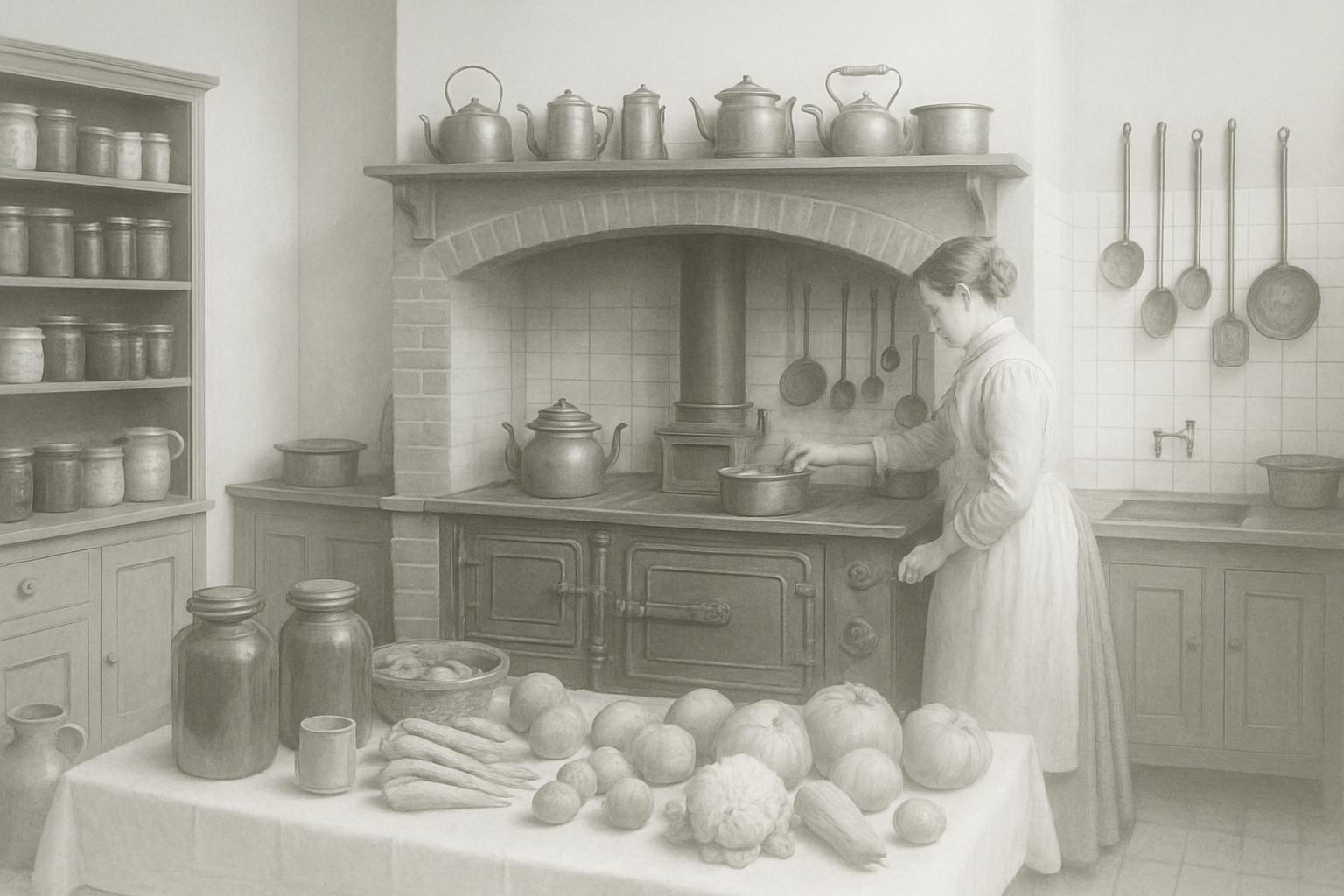
The heat of the cast-iron range dominates the space. Dampers regulate the oven; ash must be cleared hourly.
Fuel is labour, not a switch.
By afternoon, the day’s waste becomes compost for the gardener’s wheelbarrow — the cycle turning on itself, elegant and whole.
Wednesday — Preserving Day: Storing the Season.
Wednesday belongs to the jars.
It is the day of boiling, sealing, salting, and patience. The air thickens with vinegar and sugar, smoke and steam.
From The Whole Art of Curing, Pickling, and Smoking (1847):
“Let not the meat or fruit be delayed; for in delay lies waste, and in haste lies spoil. Work clean, work steady, and the winter shall not find you wanting.”
Jam pots are filled with gooseberries and currants, pickling crocks with onions, beetroot, and cabbage.
Salted meats hang in the cool passage, cheesecloths drip amber liquid from the ceiling hooks.
This is the true self-sufficiency — continuity of care.
The week’s garden yield becomes the winter’s sustenance, each jar a small victory over scarcity.
The garden’s purpose now echoes through the kitchen: abundance translated into endurance.
Thursday — The Dairy and the Range
Thursday opens with the rhythm of the churn.
Cream is skimmed from yesterday’s milk, butter worked by hand, the faint tang of buttermilk filling the dairy.
James Long and John Benson, in Cheese and Cheese-Making, Butter and Milk (1895), describe
“the morning’s milk to butter by noon, by the same hand that kneads the bread.”
Meanwhile in the kitchen, the cast-iron range glows with life.
Coal is fed, pans rotated, oven doors opened and closed to test heat by instinct — no dial, no gauge, just experience.
Vegetables from the garden meet butter and herbs in iron pots; bread rises near the warmth of the hearth.
Each sound — the whisking of cream, the hiss of water on iron — becomes part of a shared language between labour and sustenance.
Outside, the gardener turns compost and checks the frames, already thinking of next week’s sowings.
The household is not still; it breathes in rhythm with the soil.
Friday — The Fruit Wall and the Root-Store
Friday moves back to the garden.
The fruit walls are heavy with promise: espaliered pears, cordon apples, perhaps peaches under glass.
The gardener ties and prunes, ensuring sun reaches every ripening skin.
Inside, the cook descends to the root-store: barrels of sand-packed carrots, crates of turnips, onions hanging in braided ropes.
Each layer is inspected, spoiled roots removed, jars re-sealed.
In The Amateur’s Kitchen Garden, Hibberd reminds readers that hygiene and vigilance were as vital as cultivation:
“Let all stores be kept dry, cool, and aired; for the gardener who watches not his stores will find his labour undone.”
Friday is maintenance — quiet, steady, essential.
The kitchen and garden whisper together, ensuring nothing goes to waste.
Saturday — Market, Cleaning, and the Week’s Accounting
Saturday brings both bustle and reflection.
Even the most self-reliant home must visit the market: sugar for jam, salt for meat, tea for guests, perhaps fish for Sunday.
The mistress records each expense in the housekeeping ledger — “however small,” as Beeton insists.
The gardener cleans tools, oils the shears, and repairs the frames.
The kitchen-maid scours the copper pans until they glow; the cook turns leftover bones into broth and sets a stew for Sunday’s dinner.
In the late afternoon, the house falls into order.
The floors are scrubbed, jars labelled, the range polished.
Everything gleams with readiness — a small domestic sabbath earned through labour.

Sunday — The Family Table
Sunday is the reward.
The family gathers for the main meal of the week — a roast accompanied by greens, preserved fruits, and fresh bread.
Each dish tells the story of the week: the gardener’s labour, the cook’s craft, the kitchen-maid’s hands.
After dinner, the family strolls through the kitchen garden, admiring the order and abundance.
The gardener points out next week’s plantings; the mistress notes what must be replaced in the pantry.
There is no separation between soil, kitchen, and table — only rhythm.
The Hidden Labour of Self-Sufficiency
Without electricity, every process was manual:
It is easy to romanticize the Victorian household as a tranquil idyll of jam jars and roses.
But beneath every gleaming jar was labour — the constant, embodied effort of servants, gardeners, dairy-maids, and housekeepers.
- Fires had to be maintained hour by hour.
- Water drawn and boiled.
- Food cooled, stored, sealed, and rotated by hand.
Mrs Beeton’s detailed instructions for servants and kitchen hierarchy reveal a system built on skill and endurance.
Self-sufficiency was not leisure — it was discipline, time, and attention.
When we speak of reviving these traditions today, we must do so with honesty and respect: not nostalgia for servitude, but gratitude for craft.
The knowledge of preservation, timing, and soil management remains a heritage worth reclaiming.
From Country to City — The Divide
The gulf between rural and urban life was enormous.
Country homes might have half an acre of kitchen garden, a dairy, and storage rooms.
Urban workers lived by the market, with little space or means to grow.
Writers like Henry Mayhew in London Labour and the London Poor (1851–61) describe the working classes’ meagre diets — bread, tea, scraps of vegetables, and rarely meat.
Self-sufficiency was a privilege of land and labour.
For today’s readers, this contrast invites reflection:
while few of us have Victorian walled gardens, the principles of self-reliance still translate — container gardening, fermentation, small-batch preservation.
What matters is not scale, but rhythm.

Lessons for the Modern Home
The Victorian kitchen garden teaches more than horticulture. It reveals a philosophy of attention.
Grow with intention: Plant for usefulness, not display. Herbs, roots, greens — simple, sustaining food.
Preserve weekly: Make one day for bottling or freezing; treat it as ritual.
Respect fuel and time: Cook slowly, waste nothing.
Label and rotate: Every jar, every store, recorded and used.
Accept labour as craft: The work itself connects you to the rhythm of the earth.
See the garden as the kitchen’s breath: What the soil exhales, the kitchen inhales.
These principles resonate with another Mirrorfire theme we wrote on our sister site about awakening through reconnection.
They reflect the same wisdom explored in Breaking the Illusion of Helplessness —
that true independence begins with knowing the sources of our sustenance.
Reflections — Soil, Flame, and the Circle of Care
To live a week in a Victorian kitchen-garden household is to step into a circle of care:
the gardener tending soil, the cook tending flame, the housekeeper tending order.
Every act — digging, blanching, stirring, sealing — was a thread in the same web of survival.
And beyond survival, it was a gesture of gratitude: to the earth, to the craft, to the continuity of life itself.
For us, this is not about nostalgia.
It is remembrance — of what it meant to live with the world rather than merely in it.
The Victorian kitchen garden shows us that sustenance is sacred when approached with patience, skill, and reverence.