🌾 The Wild Manchester Plan — Back to Self-Sufficiency
Before progress, there was pattern. Before industry, there was understanding.
Our ancestors lived by the pulse of the land — and though modern life has dulled that instinct, it still waits beneath the noise.
To forage, to harvest, to tend — these are not survival tricks, but languages of belonging.
This plan weaves together three ancient threads — foraging, harvesting, and husbandry — into one living guide for reconnection.
It also acknowledges the truth: the journey back to balance is not easy, but it is deeply human.
🌍 Why This Path Matters
We live in an age of conveyor-belt abundance — a world where food comes boxed, processed, and preserved beyond recognition.
Supermarket shelves overflow with products that promise convenience, yet most are built from the same ingredients: sugar, seed oil, starch, and additives.
They fill the stomach but starve the spirit, leaving families dependent on what is cheapest rather than what is nourishing.
For many, the only option has become bargain food — mass-produced, chemically enhanced, and stripped of life.
It is food designed for profit, not vitality. The cost is hidden: in rising illness, in lost energy, and in the quiet erosion of skill and connection.
To return to the land — even in small ways — is to reclaim that lost agency.
A jar of homemade jam, a loaf baked with foraged berries, a bowl of nettle soup: these are not quaint hobbies but acts of quiet resistance.
Each one says I choose to remember what food once meant.
Self-sufficiency, then, isn’t about turning away from the world — it’s about turning toward what’s real again.
It’s how we rebuild health, dignity, and relationship from the roots up.
⚖️ The Honest Reality
To live from the land takes patience, humility, and seasons of learning.
There will be mistakes, scarcity, and discomfort.
But each small success — a jar of jam, a dried bundle of herbs, a fire started from gathered sticks — rebuilds the bridge between survival and reverence.
Start slowly.
- Begin with nettles, wild garlic, and blackberries — the forgiving teachers of the wild.
- Learn preservation through jams, ferments, and teas.
- Keep a forager’s notebook to mark where and when things grow.
- Each year, add one new skill — mushroom ID, weaving, cordage, or smoke curing.
Over time, knowledge turns into rhythm, and rhythm becomes resilience.
📺 The Survival Myth
Modern media has turned survival into spectacle — a kind of adrenaline-fuelled theatre of fear.
We’re shown men eating beetles in the wilderness or building shelters from scratch with a camera crew nearby, and told this is how you stay alive.
But the truth is quieter.
Real survival isn’t a stunt — it’s what our grandparents did every day.
They didn’t call it survival when they:
- Cooked broth from leftover bones,
- Preserved fruit for winter,
- Stored roots in sand under the stairs, or
- Made soap, candles, and vinegar from scratch.
What we now label “prepper skills” were simply the daily literacy of life until the middle of the last century.
They weren’t taught for emergencies; they were practiced for continuity.
To revive them now is not to retreat from civilisation, but to re-civilise ourselves in a truer way — grounded, practical, interdependent.
🗓️ Wild Harvest Calendar — Foods, Medicines, and Materials
| Month | Wild Foods | Medicinals | Materials / Other |
|---|---|---|---|
| January | Chickweed, winter cress | Pine needle tea (vitamin C) | Birch resin for waterproofing |
| February | Young nettles, cleavers | Dandelion root | Willow bark fibre |
| March | Wild garlic, violets | Ground ivy (respiratory) | Birch sap collection |
| April | Sorrel, hawthorn buds | Plantain (skin healing) | Nettles for cordage |
| May | Elderflower, dandelion | Meadowsweet, yarrow | Dandelion latex |
| June | Chanterelles, wild strawberries | St John’s Wort | Lime blossom fibre |
| July | Bilberries, raspberries | Mugwort, chamomile | Hazel poles, bark |
| August | Blackberries, crab apples | Nettle seed (adaptogen) | Rosehips for drying |
| September | Sloes, hawthorn berries | Elderberries (immune tonic) | Oak galls (tannin) |
| October | Chestnuts, mushrooms | Burdock root | Beech leaves, nuts |
| November | Late fungi, rosehips | Coltsfoot root | Reeds and rushes |
| December | Pine nuts, sea buckthorn | Spruce tips | Ash bark strips |
Each month carries its own medicine.
The key is not to take everything, but to understand what the season offers — and what it asks you to leave behind.
🌾 Common Wild Uses
| Resource | Type | Use | Preparation |
|---|---|---|---|
| Nettle | Food / Medicine | Iron-rich greens, tonic tea | Blanch, dry, or steep |
| Dandelion | Food / Medicine | Liver & digestive tonic | Roast root, boil for decoction |
| Elderflower / Berry | Medicine | Anti-viral syrup | Infuse or boil to syrup |
| Plantain | Medicine | Wound and bite poultice | Crush fresh or dry for tea |
| Hazel | Food / Material | Nuts, poles | Harvest nuts late Sept |
| Rosehip | Food / Medicine | Vitamin C syrup | Slow simmer, strain, sweeten |
| Pine Needles | Medicine | Respiratory and immune | Steep fresh needles for tea |
🐇 Wild Protein and Ethical Game
A relationship with the wild must include honesty about life and death.
In Britain, certain species — rabbit, pigeon, and grey squirrel — exist in such abundance that responsible harvest actually supports ecological balance.
🪶 Scenario 1 — Times of Moderate Need
(Skill-building, resilience, ecological respect)
| Species | Rationale | Guidance |
|---|---|---|
| Wood Pigeon | Abundant crop pest | Avoid breeding season; use all parts (meat, bone, feathers) |
| Rabbit | Common farmland species | Dispatch humanely, cook thoroughly, save skin for tanning |
| Grey Squirrel | Invasive, displacing red | Humane trapping only; mild meat, pelt reusable |
🔥 Scenario 2 — Times of Critical Need
(System collapse or prolonged scarcity)
| Species | Value | Notes |
|---|---|---|
| Above species + Waterfowl / Corvids | Readily available protein | Sanitation vital; smoke or salt for storage |
| Deer (where legal) | High yield, full utility | Use hide, bone, sinew; never waste the life given |
Even in crisis, ethics remain: take what you need, waste nothing, and give thanks.
The act of eating becomes sacred again.
🌿 From Foraging to Harvesting
| Aspect | Focus | Purpose |
|---|---|---|
| Wild Cultivation | Encourage edible weeds, coppicing | Increase yield without control |
| Seed Saving | Preserve local and heirloom species | Ensures future abundance |
| Preservation | Drying, fermenting, smoking | Stores nutrients through winter |
Harvesting bridges the gap between wilderness and stewardship — you begin not just to take, but to tend.
🐑 From Harvesting to Husbandry
| Aspect | Focus | Purpose |
|---|---|---|
| Small Livestock | Chickens, bees, rabbits, ducks | Consistent protein, pollination, compost |
| Perennial Food Systems | Fruit trees, herb spirals | Low-input, high-return systems |
| Compost & Soil Care | Organic loops | Returns nourishment to the land |
Husbandry is not dominion — it’s companionship.
To keep animals or crops well is to live within nature’s rhythm, not above it.
🔄 The Three Pillars of Self-Sufficiency
| Pillar | Description | Outcome |
|---|---|---|
| Hunting & Gathering | Reconnects you with wild systems | Skill, resilience, gratitude |
| Harvesting | Cooperation with semi-wild landscapes | Year-round sustainability |
| Husbandry | Regenerative care for tended life | Stability, abundance, stewardship |
Together, these create a closed circle — a life of balance, where nothing is wasted, and everything returns.
🌱 The Gentle Introduction
| Season | Practice | Lesson |
|---|---|---|
| Spring | Nettle and wild garlic foraging | Renewal, simplicity |
| Summer | Jam-making, herb drying | Abundance, patience |
| Autumn | Seed saving, berry syrup | Continuity, gratitude |
| Winter | Crafting, candle-making | Stillness, preparation |
Each small act — a jar, a walk, a weave — restores something ancient in the modern mind.
🪶 Passing It Down
Knowledge that isn’t shared becomes superstition.
Knowledge that is shared becomes culture.
Bring others into your learning — children, neighbours, friends.
Teach them what the leaves say about the season, how the soil smells before rain, how a plant can heal if approached with care.
The goal is not personal escape, but collective remembering.
The most valuable harvest is wisdom that outlives us.
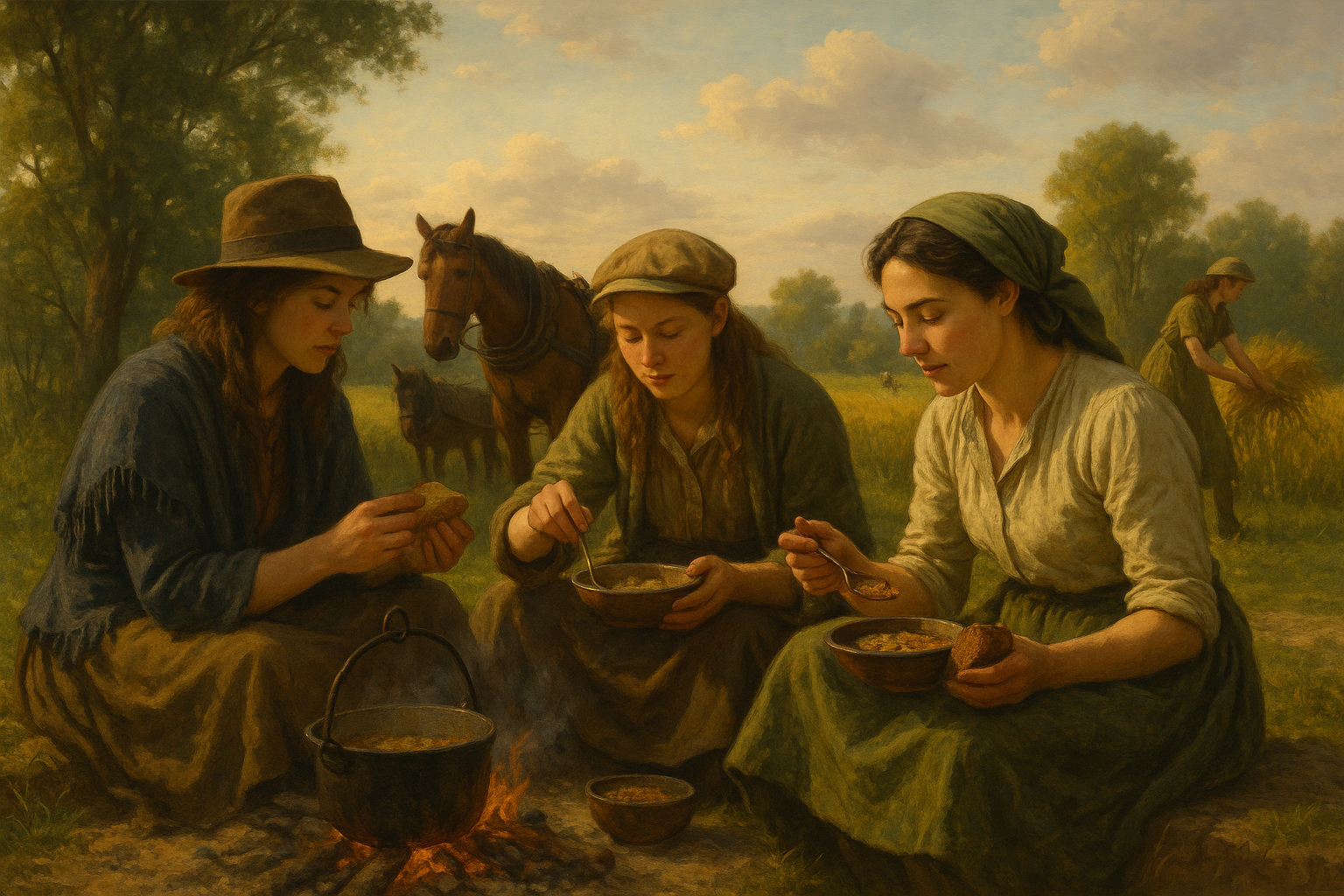
🔥 The Traveller’s Meal — An Example from the Old Ways
Imagine an autumn evening after a long walk through hedgerows heavy with berries.
A small fire, a blackened pot, the scent of woodsmoke.
Into the pot go foraged greens — nettle, sorrel, and young dandelion leaves — simmered in a stock made from a single wood pigeon caught earlier that day.
A handful of barley or foraged chestnuts thickens the broth.
Beside it, rosehip tea brews slowly, crimson and bright, the taste of summer preserved in warmth.
This is not luxury, yet it nourishes completely: protein, minerals, vitamins, and story.
It’s the same kind of meal that travellers once carried in memory, moving between villages and forests, living lightly, respectfully, freely.
Each ingredient gathered by hand, each bite blessed by effort — a reminder that real food and real life are the same thing.
🌾 Closing Reflection
To live self-sufficiently is not to reject the modern world,
but to re-root within it — to remember that sustainability was once simply called life.
The Wild Harvest Plan is not about control.
It’s about rhythm, humility, and the quiet joy of knowing that whatever the world forgets, the Earth still remembers.

