The Skin of the Earth
Moss is the Earth’s first mercy.
It spreads where other life cannot — across stone, marsh, and the wounded skin of the world.
Sphagnum, the bog moss, is a quiet alchemist: drawing in water, holding it, softening it, purifying it.
When we kneel to touch it, we touch an ancient intelligence that does not shout, but listens.
In stillness, life restores itself.
Moss asks for nothing but patience — light filtered through clouds, water slow enough to rest. It thrives by humility, thriving where grandeur fails.
The Battlefield Gatherers
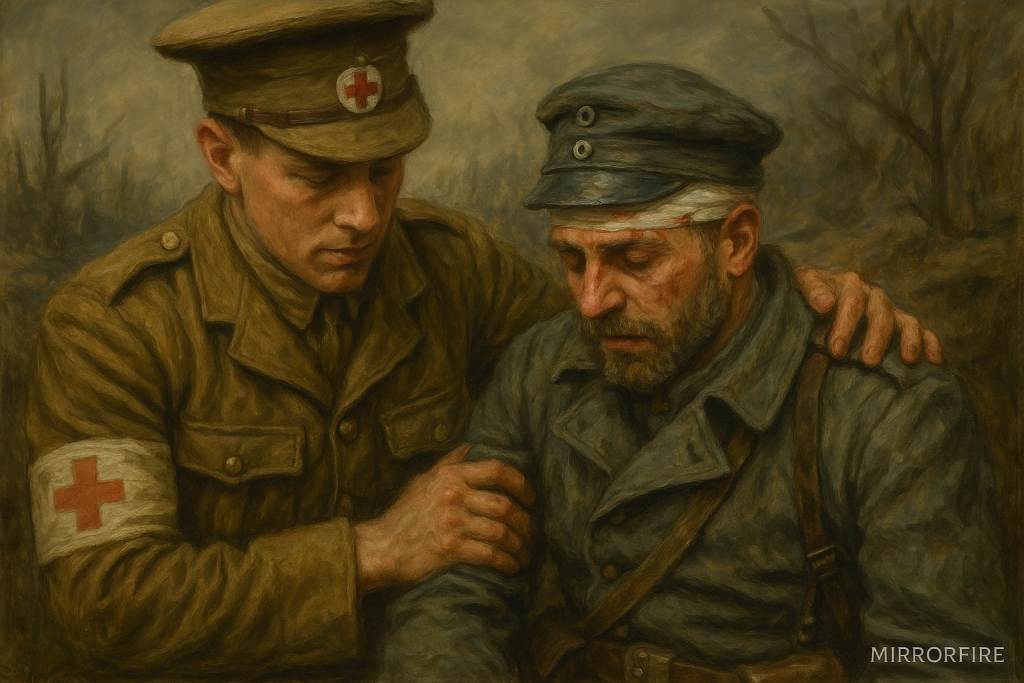
When the world went to war, it was not the machines that healed the soldiers — it was moss.
By 1916, cotton was scarce. The Red Cross called for substitutes, and across Scotland, Ireland, Canada, and the Pacific Northwest, volunteers — women, children, and elders — waded into bogs to gather Sphagnum moss.
They wrung it, dried it, and stitched it into muslin pads.
The British Bryological Society recorded how these field dressings absorbed twenty times their own weight and created a naturally acidic environment that inhibited bacterial growth.
In Canada, according to Smithsonian Magazine, railcars left Nova Scotia filled with crates of dried Sphagnum bound for France.
Local newspapers told of “moss drives,” where schools closed and children filled sacks for the Red Cross.
By late 1917, Britain was producing over a million moss dressings each month — their faint scent of forest replacing the sterile smell of cotton.
Nature’s softness became the soldier’s salvation.
This is the quiet paradox: the gentlest plant became the healer of the most violent wounds.
Moss as Filter and Guardian
Even before its wartime service, Sphagnum was the Earth’s own medic — a natural purifier.
Its fibrous structure draws out impurities and balances acidity, turning bog water into clear reservoirs of life.
The slow percolation through peat layers filters microorganisms, metals, and decay.
Indigenous peoples and northern settlers understood this long before laboratories confirmed it: moss makes water clean.
But not for eating — its gift is not nourishment but purification.
To drink through moss is to taste what the Earth has already forgiven.
Moss teaches us to hold what is unclean until it becomes clear again.
Moss and Lichen — Knowing What Heals
Not all that grows upon stone can be eaten.
Moss itself is non-toxic yet indigestible — its fibers are pure cellulose, meant for soil and sponge, not for stomach.
Its lesson is one of cleansing, not consumption.
Lichens, those strange marriages of algae and fungus, live on the edge of sustenance and poison.
The Arctic’s Iceland moss (Cetraria islandica) once fed travelers when boiled or dried, its bitterness softened by heat.
Yet others, such as wolf lichen (Letharia vulpina), hold acids that can burn from within.
So the lesson is clear: discernment.
What heals the wound may not feed the body — and what feeds the body may dull the spirit.
Purity is not found in what we swallow, but in what we release.
The Memory of the Marsh
In the stillness of sphagnum bogs lie preserved bodies — ancient faces serene beneath the peat.
Their flesh remains where centuries have turned to silence.
Sphagnum’s acids and stillness preserve what falls within; it remembers without judgment.
Time stands still in moss.
It is memory made flesh, a living archive of the Earth’s own reflection.
Here we glimpse the Mirrorfire truth: preservation through reflection, cleansing through gentleness, awakening through stillness.
Where fire burns away ignorance, moss cools the wound that remains.